


The two-minute timeout
Last week, I increased a timeout on a single API call to two minutes.
Not for complex machine learning inference. Not for processing terabytes of data. Not for rendering 3D visualizations.
For this query: “What’s the latest order for this email address?”
We now wait up to two minutes to answer a question a competent intern with a spreadsheet could answer in ten seconds. And here’s what’s driving me insane: we just accept this. We shrug and say “OMS integrations are slow” like it’s a law of physics instead of a choice.
The absurd comparison
Meanwhile, I can ask Claude to analyze a complex codebase, write an essay on philosophical concepts, generate a complete API with tests, debug race conditions, or explain quantum physics to a five-year-old.
Response time? Three seconds.
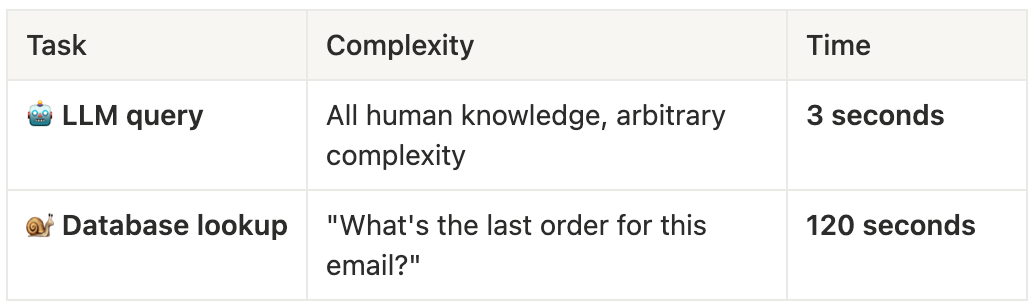
We have systems processing questions of arbitrary complexity, returning answers that would’ve taken teams of researchers weeks to compile – faster than you can say “please hold.”
But a simple database lookup? Two. Entire. Minutes.
Your charger sent us to the moon
Your $25 USB-C charger has more computing power than the Apollo 11 Guidance Computer. Not a little more. 563 times more processing power.
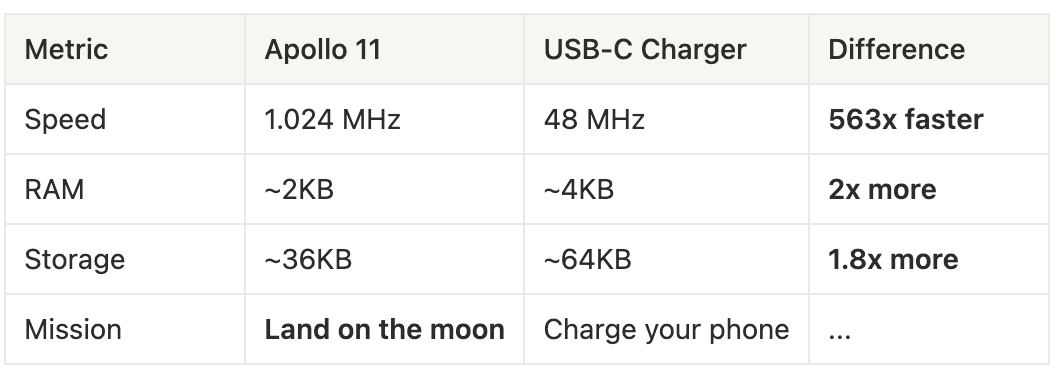
That afterthought accessory is vastly more powerful than the computer that calculated trajectories to navigate 240,000 miles through space and bring astronauts safely home.
So why does looking up an order take 120 seconds?
What we can and can’t do
What we CAN do:
Train neural networks with billions of parameters
Stream 4K video to billions of people simultaneously
Sync data across continents in milliseconds
Put AI chips in chargers (they negotiate power delivery in real-time)
What we apparently CAN’T do:
Basic database lookups in under a minute
The same industry that puts AI in your charger can’t figure out how to index a database properly.
The boiling frog
We’ve developed collective tolerance for terrible software. Each year, things get slightly slower, slightly more bloated, slightly more “that’s just how it works.” And because it’s gradual, we adapt.
We add caching layers. Implement retry logic. Increase timeouts. Tell users “this might take a while.”
We’ve normalized waiting.
We have an entire design language dedicated to making waiting feel less terrible: spinners, progress bars, skeleton screens.
What if instead of designing better loading states, we just made things fast?
Complexity isn’t an excuse
I know why the OMS query is slow. Years of technical debt. Legacy systems. Databases that were never meant to scale this way. Integrations bolted onto integrations. Third-party APIs. Vendors who won’t prioritize performance.
Complexity is real. But we’ve accepted it as an excuse rather than treating it as a problem to solve.
Somewhere along the way, “it’s complicated” became a valid reason for terrible performance. We’ve let our systems become so Byzantine that two-minute queries seem reasonable.
The real problem
Companies running LLMs:
Millions of requests per day
Billions of parameters per request
Natural language understanding (science fiction a decade ago)
Response time: 3 seconds
Your database:
Looking up a single row
Technology from the 1970s
Response time: 120 seconds
The problem isn’t that we lack the technology. We’ve built systems so poorly that even simple operations require heroic infrastructure to function at all.
A failure of priorities
At Neople, this frustration drives how we think about software.
When Nora (our digital colleague) can understand complex workflows and adapt to human needs in real-time, but a basic order lookup takes two minutes? That’s not a technical limitation – that’s a failure of priorities.
We’ve been so focused on adding features, scaling up, and moving fast that we forgot to ask: “Does this actually work well?”
Not “does it work?” but “does it work well?”
We have the technology
Look at your laptop charger. That little box is more powerful than the computer that took us to the moon.
Now think about the last time you waited 30 seconds for a page to load. The last timeout error. The last “system is running slow today.”
We have orders of magnitude more computing power than the engineers who achieved humanity’s greatest feats.
We just need to stop accepting slow as the default.
If we could navigate to the moon with less computing power than your charger, we can look up an order in under two minutes.
