


There is a category of task that falls through every crack in a company. Not because it’s hard. Not because it’s unimportant. But because it lives right at the intersection of content, design, IT, and HR, and belongs fully to none of them.
Email signatures are the Bermuda Triangle of marketing ops.
I know this because the email signature problem has now found me three times.
The first time was a full rebrand. Hundreds of assets, all updated, all on-brand. The last item on the list — basically the final boss — was company signatures. Which, on paper, sounds easy. In practice, meant digging into Gmail settings, realizing there was no clean way to do this at scale, researching a dozen different solutions, and finally landing on something that worked. Fine. Not beautiful. But done. I crossed it off the list with the quiet dignity of someone who has been humbled.
The second time, I was at a new company. Smaller team. No real ownership of signatures anywhere. I got asked about them, put together a fix: found an HTML template, manually filled in names and titles with some AI assistance, sent them out individually. Employees still had to copy, paste, customize, and actually install the thing themselves. Fine. Functional. A solution in the way that a bandage is a solution.
The third time, someone asked me how to update their signature to remove an event that had already happened.
And something in me cracked.
Not dramatically. Quietly. The way you feel when you realize you’ve answered the same question for the third time and could have just fixed the thing instead.
So this time, instead of going back to the HTML, I went to Claude. I described what I wanted: a tool where any employee could fill out a simple form — name, title, which events to include — and get back a ready-to-install email signature that was perfectly on-brand without ever touching a line of code.
Forty-five minutes later, I had it.
Not “mostly there.” Not “rough draft that needs a developer to finish.” A working tool, now living in our Webflow, that any of our team can use. The HTML lives behind the form. Nobody ever sees it. Nobody needs to.
Here’s what I actually built, and how:
I started by explaining the problem to Claude in plain language — what the signature needed to contain, what “on-brand” meant for us (colors, fonts, spacing), and what the output needed to be. I uploaded a reference signature so it had something concrete to work from.
Then we just... built it. Back and forth. I’d test it, tell Claude what was off, it would fix it. The pronoun field wasn’t displaying right. Fixed. The event section needed to be optional, not just blank when unused. Fixed. The copy-to-clipboard button wasn’t working cleanly on mobile. Fixed.
The whole thing took less time than my last attempt to explain the problem to someone.
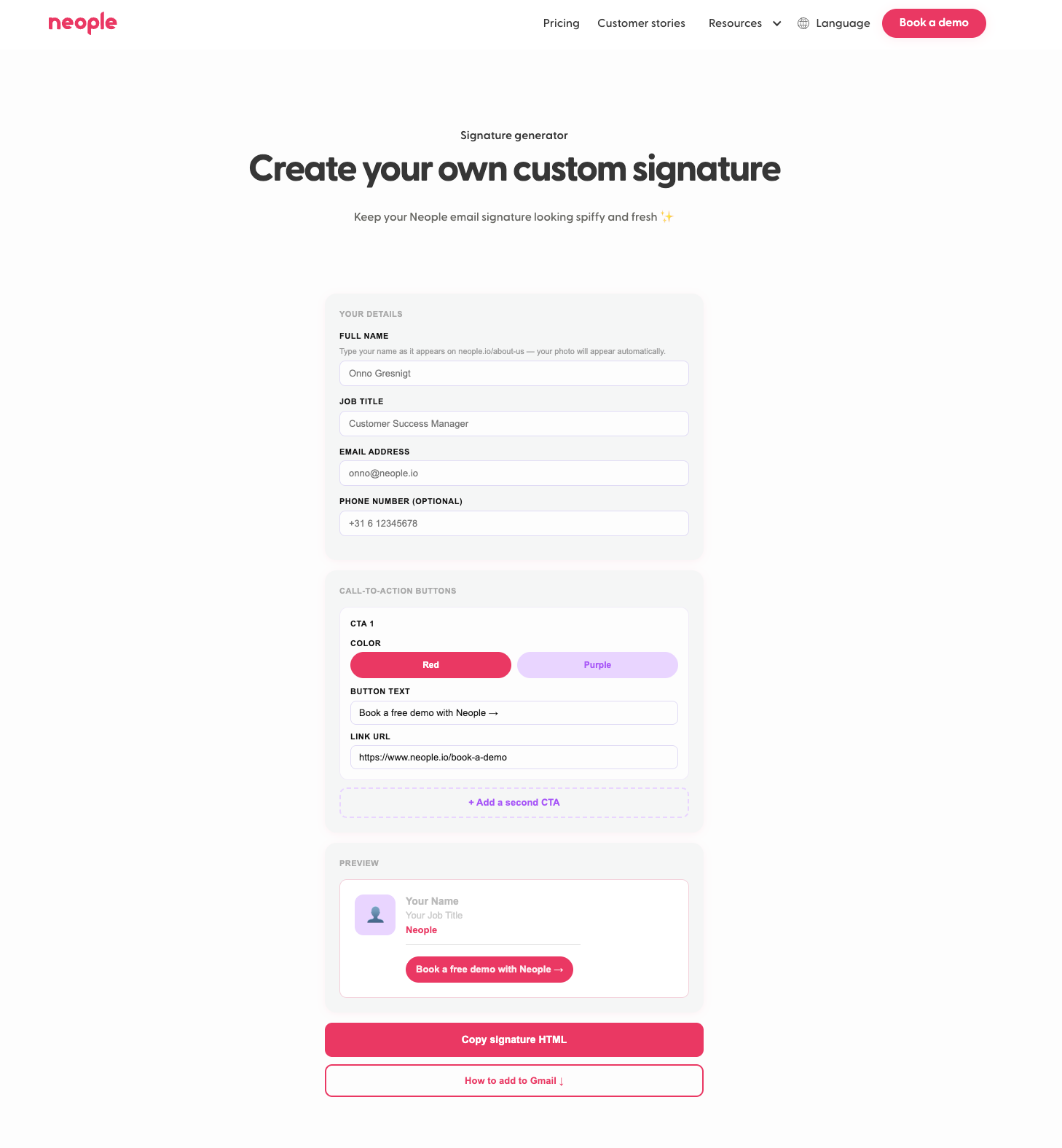
Curious about how it works? (The profile pictures automatically best-match the name against our database of employee photos on Webflow 🥹)
I’ve been working in marketing and content for almost nine years. I am not a developer. I don’t know how to code. And I built a genuinely useful internal tool in under an hour because I was able to describe a problem clearly and iterate on a solution.
That’s the thing I keep coming back to. If you can brief a freelancer, you can brief AI. Same skill: explain the goal, share a reference, give feedback until it’s right. I wasn’t coding. I was just briefing.
The email signature problem didn’t need a developer. It needed someone who was sick of solving it the hard way.
The third time, that was enough.
Neople exists to help people find more joy in their work. That’s the whole mission. And look — I’m not going to claim that a email signature generator is the most profound expression of that idea. But if I never have to open an HTML file, manually swap out a colleague’s name, and paste it into their Gmail settings ever again, I will be, genuinely, more joyful.
Sometimes that’s what it looks like.